To compare marketing providers fairly, send every one the same short question sheet and judge the written answers against your own brief. Proposals differ in format, price structure and vocabulary, so comparing them as received mostly rewards the best presentation. A shared sheet moves the comparison to scope, evidence, access, reporting and what happens if you leave. This guide is for small service businesses in Istanbul and teams buying marketing for international customers. It includes a fictional worked example and a scoring note. It does not tell you which provider to choose, and nothing here promises rankings, enquiries or any other result.
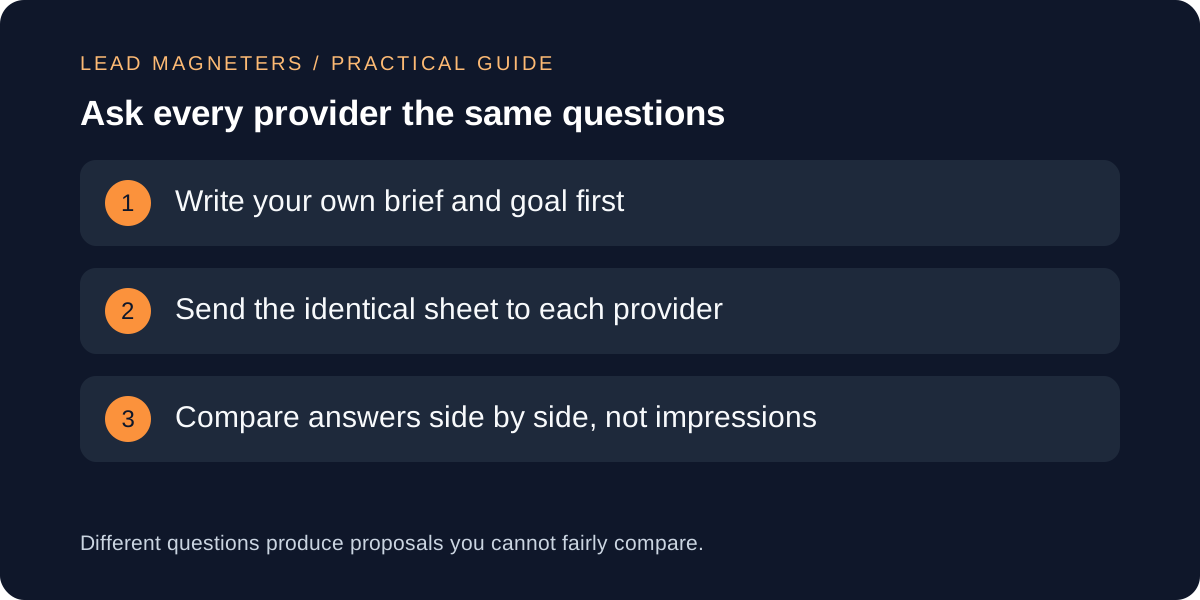
Write your own brief before you ask anyone anything
Providers can only answer well if you have said what you need. Write half a page: the services you sell, the customers and markets you want, the one decision the work should help you make, and the budget range you can actually commit. Include what you already have, such as a website, a Google Business Profile or an advertising account, because that changes the scope of any proposal.
Keep the brief neutral. If it already names a channel or a tactic, every provider will propose that tactic and you lose the chance to see who questions your assumptions. A brief built around a decision and a boundary lets you notice which providers ask good questions back. Fictional example: a dental-supplies reseller in Istanbul writes that it wants to know whether enquiries from two export markets justify a paid test, with a monthly range it can commit. Three providers receive the same brief and the same sheet. One answers only with a price list, one returns scoped answers with exclusions, and one asks which enquiries the reseller currently counts as qualified. The reseller can now compare those answers directly. This example is invented and is not a client result.
Ask what is in scope, and what is not
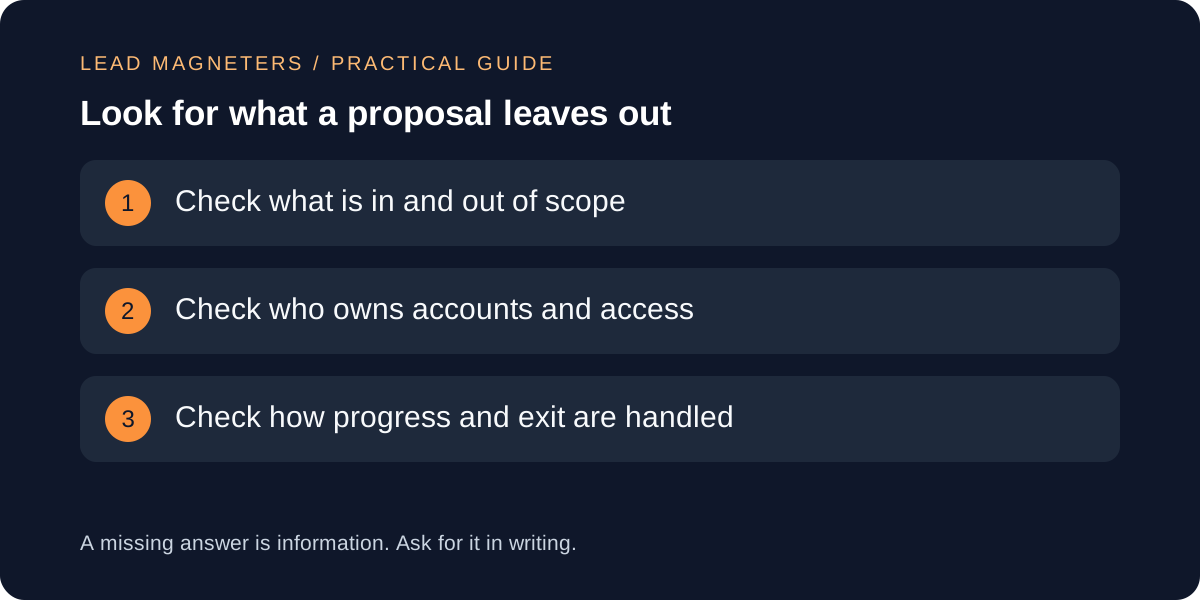
Ask each provider to list deliverables in plain terms: what will be produced, how often, by whom and in what form. Ask what is explicitly excluded, for example content writing, translation, landing page changes, creative production or ad spend. Two quotes with different prices often cover different work, and the exclusions list is where the difference hides.
Ask who does the work and how it is supervised. Some agencies use specialists in-house, some use freelancers, some use partner firms. None of these is wrong, but you should know which applies, who your day-to-day contact is and what happens if that person leaves.
Ask for evidence, and read it carefully
Ask for examples of past work and how success was measured. Google's own guidance for people hiring an SEO suggests asking for examples and success stories, how results are measured and what experience the provider has in your industry and location. Treat a case study as one provider's account, and check whether it states the period, the starting point, what else changed and who approved publication.
Ask what the provider would not claim. Google states that no one can guarantee a number one ranking, and that a promise of first place is a reason to look elsewhere. The same caution applies to guaranteed lead volumes or guaranteed advertising returns. A provider who explains what can be estimated and what cannot is giving you more useful evidence than one who offers certainty.
Read how a verifiable case study is built →
Ask about access, ownership and methods
Ask who will own each account, such as analytics, advertising, Search Console, the domain and the website. Prefer arrangements where your business is the owner and the provider is a named user. Google Ads Help describes granting and removing user access and recommends more than one administrator for tag management, so a single person leaving does not lock you out. Ask which access level each task needs and request only that level.
Ask for the methods in plain language, including how links are obtained. Google's spam policies describe buying links that pass ranking credit, automated link creation and low-value content produced mainly to manipulate rankings as practices to avoid. Because you are responsible for the actions of any company you hire, ask whether the provider will tell you about each significant change they make and why.
Ask how progress is reported and how you can leave
Ask what the first report will contain, how often you will receive one, which data source each figure comes from and how enquiries will be tied to the work. Ask what happens when numbers are unclear or disappointing, and who decides the next step. Reports that only list impressions or clicks leave you unable to judge whether the work supports your decision.
Ask about the contract: minimum term, notice period, what you receive on exit, and whether you keep content, creative files and account access. Also ask when the provider would recommend pausing or stopping. Answers that are specific and written down make the proposals comparable, and vague answers are worth noting rather than guessing past.
Score the answers and keep the record
Put the providers in columns and the questions in rows. Mark each answer as clear, partly clear or missing, and add a short note with the source, such as a proposal page or an email date. Avoid a single total score. Instead, mark any row you consider essential, such as account ownership, and treat a missing essential answer as a decision point, not a rounding error.
Keep the sheet with the date and the proposals you received. Rerun the same questions at renewal, so you compare the provider with your own records rather than memory. If a provider declines to answer a reasonable written question, record that too. The aim is a decision you can explain later, not a perfect winner.