A Meta ad creative test register is a short shared record of what you tried, why, how the test was set up and what you decided afterwards. Without one, teams swap images and headlines, remember the winners and forget the reasons, then repeat the same experiment months later. This guide is for service businesses in Istanbul and teams serving international buyers who run Meta ads and want each creative change to teach them something. It follows Meta's own A/B testing guidance, includes a fictional worked example and gives you register fields you can copy. Nothing here promises a lower cost or more leads; a register improves the quality of your decisions, not the market's response.
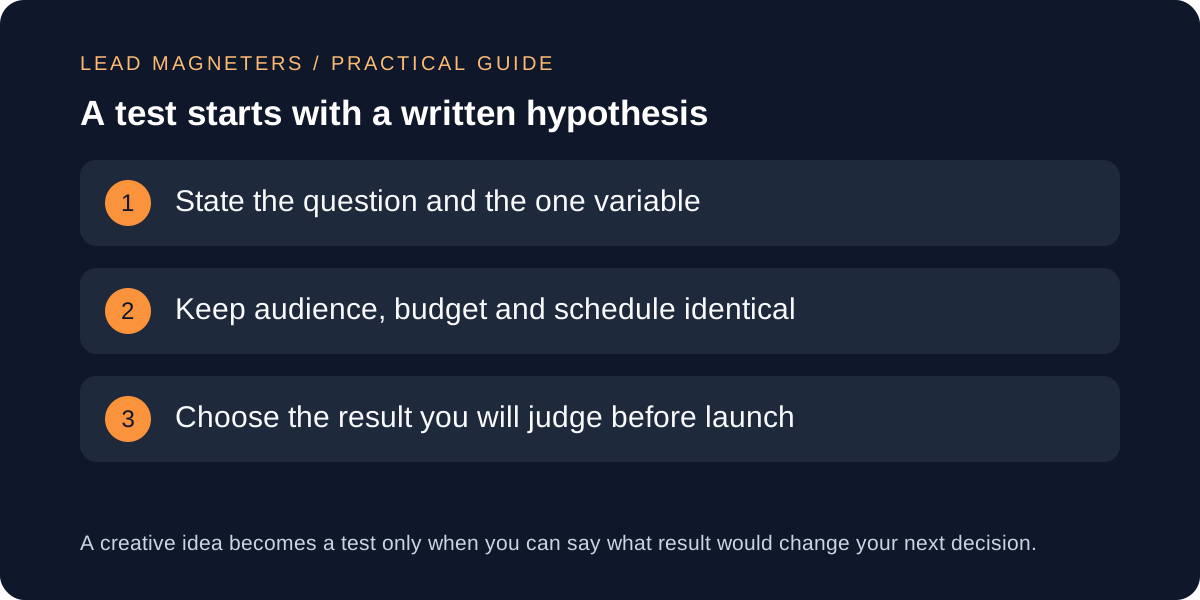
Write the hypothesis before you build the ad
Meta's help pages describe A/B testing as comparing two versions of an ad strategy by changing a variable such as an image, ad text, audience or placement, with each version shown to a separate segment so nobody sees both. They also advise choosing a hypothesis before selecting the variable. A useful hypothesis names the change and the expected effect, for example that a headline naming the buyer's problem will produce a lower cost per result than a headline naming the service.
Add the business reason to the same line. If a headline test would not change which message you use next month, it is probably not worth the budget. Record who proposed the idea, the service it supports and the landing page it points to, so the later reader understands the context and not only the creative.
Change one variable and keep the rest identical
Meta's best-practice guidance says results are more conclusive when the ad sets are identical except for the variable being tested. Its page on testing more than one variable adds a caution: you can compare two specific ad sets that way, but you will not know which variable caused the difference. If the new version has a different image, headline, audience and offer, the register can record a winner but cannot record a lesson.
Write the single variable in its own field, and list what was held constant: audience, placement, budget, schedule, destination and optimisation event. If a team member wants to change something else mid-test, write it down as a separate future test instead. For a new creative concept that is deliberately different in several ways, label it as a comparison of two complete ads, and do not claim that any one element worked.
Set up the test so the comparison is fair
Meta recommends running A/B tests in Ads Manager or the Experiments tool rather than informally switching campaigns on and off, because informal testing can cause inefficient delivery and overlapping audiences. It suggests using the same budget for both versions, and an audience large enough for the test that is not used in other campaigns at the same time, since overlap can contaminate results.
Record the tool used, the budget per version, the audience definition and the schedule. Meta recommends tests of at least seven days and allows a maximum of 30; shorter tests may be inconclusive, and a longer window suits buyers who take more than a week to convert. For a service with a long enquiry cycle, note how long you expect between ad view and enquiry, and whether the test window could capture it.
Check the budget before testing →
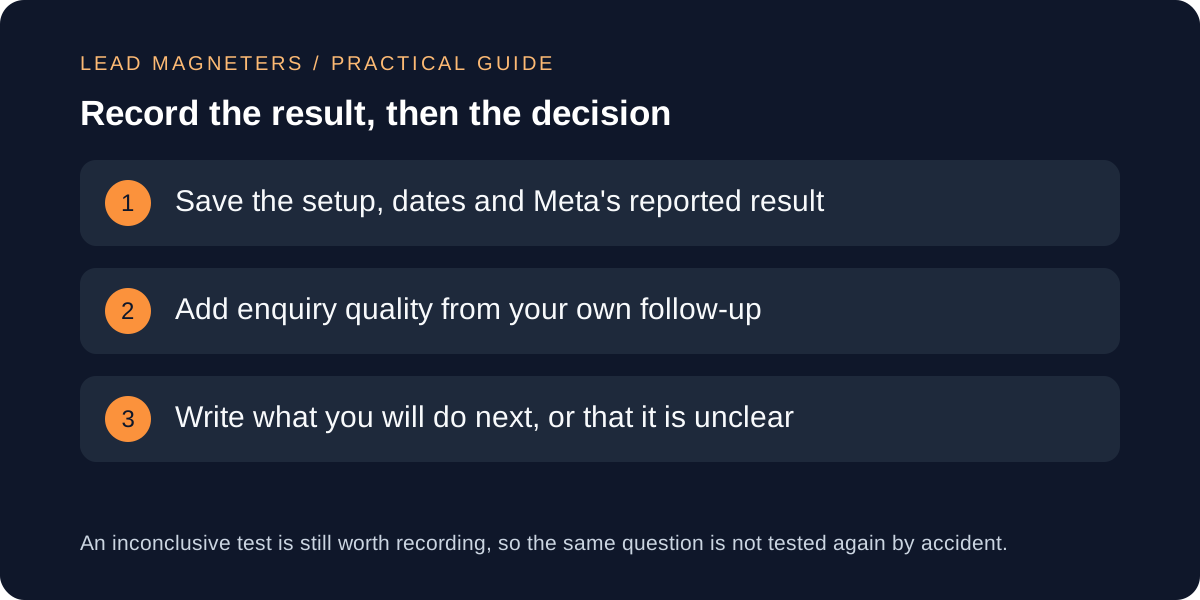
Choose the result you will judge, and read Meta's winner with care
Meta says a winner without a holdout is determined by comparing the cost per result of each campaign, where the result is the event selected when the test was created. It estimates how often each version would win by simulating outcomes many times, and reports a confidence percentage. Its help page also warns that a winning campaign can cost more when the test was too short, there were too few results or best practices were not followed.
Write the selected result and the minimum number of results you would trust before launch. Then add a second column for your own measure. A lower cost per click or per form submission does not show that the enquiries were suitable. Make sure the result event matches the primary action you actually value, in the same way you would review conversion settings elsewhere.
Add enquiry quality from your own records
Platform results stop at the platform. After the test, ask whoever handles enquiries to review the leads from each version with the same criteria: was the request within the services you provide, was the contact reachable and was a call or quote arranged. Use your CRM or a simple sheet and the same definition for both versions, and avoid recording personal details in the register itself.
Keep the counts honest. If one version produced three suitable enquiries and the other two, that is a note, not a rule. Where a loss reason is known, link it to the register so you can see whether a message attracts people who later find the service is not a fit.
A fictional example and the register fields to copy
Fictional example: Northlight Studio, an imaginary Istanbul interior renovation firm, wants more consultation requests. Its hypothesis is that an opening line asking about the buyer's renovation timeline will give a lower cost per consultation request than a line describing the studio. The only variable is that opening line. Audience, placement, budget, landing page and a nine-day schedule are identical. Meta reports the timeline version as ahead at a moderate confidence level, but the team reviews the leads and finds four suitable enquiries against three. The recorded decision is to run the timeline line again in a longer test, and not to rewrite every ad.
Copy these fields: date and owner; hypothesis; single variable; held constant; tool, audience, budget and schedule; selected result; Meta's reported result and confidence; suitable enquiries per version; decision and next test; and a limits note. Review the register before planning the next batch of creative, and discuss it with whoever manages the campaign so results are interpreted against the offer, season and follow-up speed.