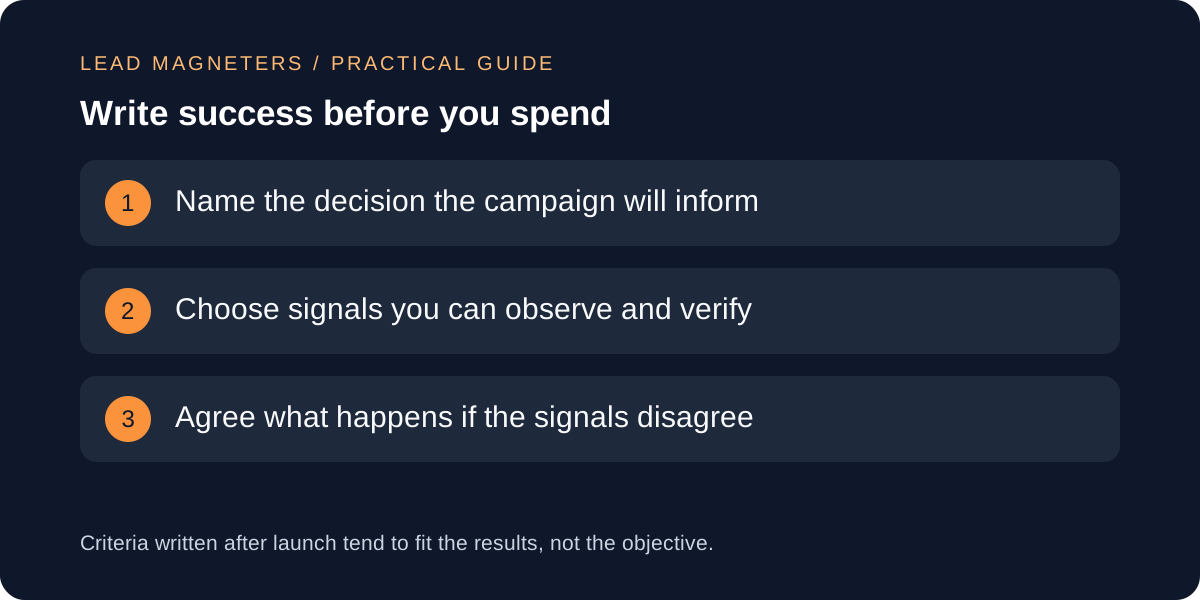
Success criteria in a campaign brief should name the decision the campaign will inform, the signals that count as progress, where each signal is recorded and what the team will do if the signals disagree. Agree them before launch, while nobody has results to defend. This guide helps small service businesses in Istanbul and teams serving international customers write criteria that are specific enough to check and modest enough to be honest. It includes a fictional example and a one-page template. It does not promise any outcome, and the example is illustrative, not a client result.
Start with the decision, not the metric
A campaign exists to help someone decide something. It might be whether a new service has enough interest to justify more effort, whether one audience responds better than another, or whether a landing page explains an offer clearly. Write that decision as the first line of the brief. A metric chosen first, such as clicks or reach, tends to become the goal by default, even when it says little about the decision.
State the decision in a form that could have more than one answer. If every possible result leads to the same next step, the campaign is not testing anything. Add a date by which the decision will be made, and name the person who makes it. That small structure keeps the review from drifting into a general discussion of how the numbers feel.
Choose signals you can observe and verify
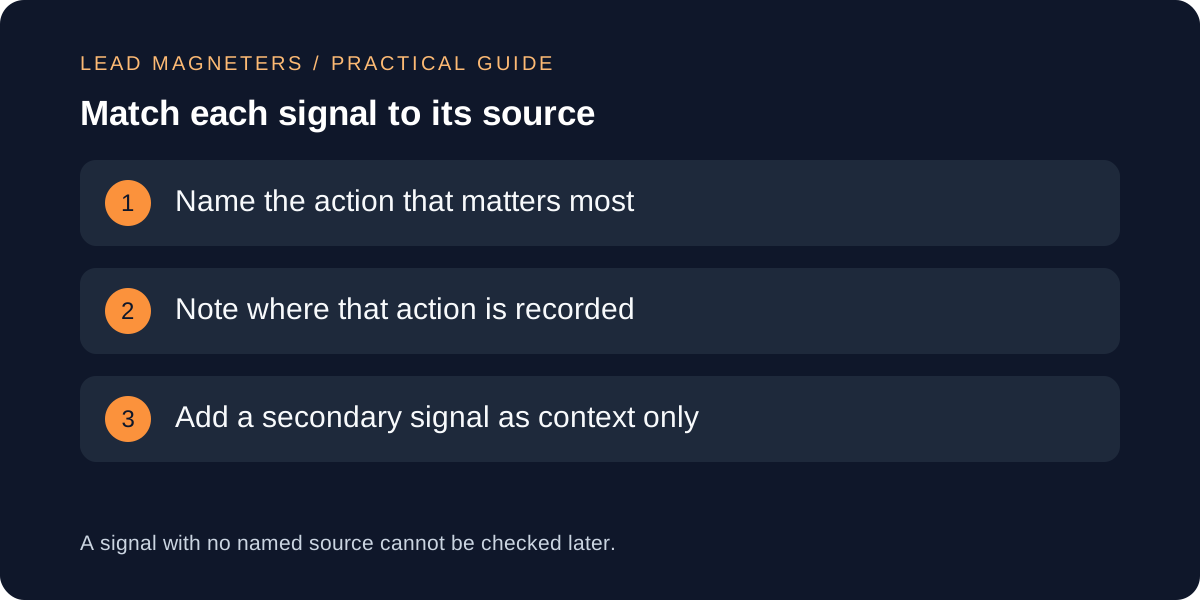
Pick one primary signal that sits closest to the decision, and a few supporting signals for context. For a service business the primary signal is often an accepted enquiry that matches the service, not a raw form submission. Supporting signals might include which pages visitors read before enquiring, or how many conversations needed clarification. Each signal should be something you can check in a record, not an impression.
Be careful with early signals. Page views and clicks are easy to count, but they do not show whether the right people took the next step. Treat them as indications of attention and keep the decision tied to a signal that reflects intent. When a signal cannot be measured yet, say so in the brief and plan how it will be recorded, instead of substituting a proxy that looks impressive.
Name the data source for each signal
For every signal, write where it is recorded and who can read it. Google Analytics describes a key event as an event that measures an action that is particularly important to the success of the business, and it lets you mark any collected event as key. If your primary signal is a key event, the brief should say which event it is and where its count appears in reports.
Advertising platforms have their own rules for which actions count. In Google Ads, primary conversion actions are the ones reported in the Conversions column and used for bidding when their goal is used for bidding, while secondary actions are for observation only. If the brief mentions a Google Ads campaign, record which actions are primary so the team does not read observation data as the objective. Platform definitions change, so check the current help pages when you write the brief.
Review primary and secondary conversions →
Set a review point and a plan for unclear results
Decide in advance when the campaign will be reviewed and how much data is enough to review. A few enquiries rarely support a firm conclusion, so the brief should say what the team will do with a small sample: continue, change one element, or record the result as inconclusive. An honest inconclusive result is more useful than a confident reading of noise.
Agree what happens when signals disagree. Perhaps enquiries rose, but few matched the service. The brief can say that the team will review the enquiry notes and the landing page before changing the budget. Writing the response in advance reduces the pull to explain away whichever number looks worst, and it gives the person who makes the decision a clear route.
A fictional example
Imagine a fictional Istanbul translation studio testing interest in a new legal-document service for overseas clients. The decision: whether to keep promoting the service next quarter or pause it. The primary signal is an accepted enquiry that names the document type and language pair, recorded in the CRM. Supporting signals are visits to the service page and the number of enquiries that need a clarifying question.
The brief sets a review date four weeks after launch and says that fewer than a handful of qualifying enquiries will be recorded as inconclusive, with one change to the page and a second review. If enquiries arrive but most are out of scope, the team will review the page wording before adjusting any budget. The studio, service and review plan are illustrative only.
Keep the brief to one page and revisit it honestly
A useful brief fits on one page: the decision, the primary signal and its source, the supporting signals, the review date, the plan for unclear results and the person who decides. Share it with everyone who will touch the campaign, including whoever handles enquiries, so they know what a good enquiry looks like.
At the review, compare the results with the criteria as written, not as remembered. If the criteria turned out to be wrong, change them for the next campaign and note why, instead of quietly rewriting the old brief. Over several campaigns this record shows which signals predicted useful enquiries and which did not, and that evidence is more valuable than any single result.