Jev is an AI model from TypeSafe AI designed to return structured decisions that software can use. Instead of asking it to write an article or hold a conversation, a program supplies information and asks specific questions about it. For a marketing team, that distinction matters: creating a customer reply and deciding which team should receive an enquiry are different jobs. TypeSafe announced Jev on September 15, 2026. This guide explains the model using official documentation checked on September 20, 2026, then proposes a practical evaluation approach for service businesses. The examples are hypothetical workflow designs, not results from a Lead Magneters deployment or a claim that Jev will improve every business process.
What is Jev, and what does System One mean?
TypeSafe calls Jev its first System One model, a category focused on quick, structured judgments inside software. Its launch announcement describes a training approach called Reinforcement Learning for Calibrated Decisions, or RLCD. The company positions this around decisions with meaningful uncertainty rather than free-form text generation. These are the developer's descriptions of the product, not independent proof that it outperforms every alternative. The useful business question is narrower: can it make a particular repeated judgment reliably enough, at an acceptable total cost, within your own workflow?
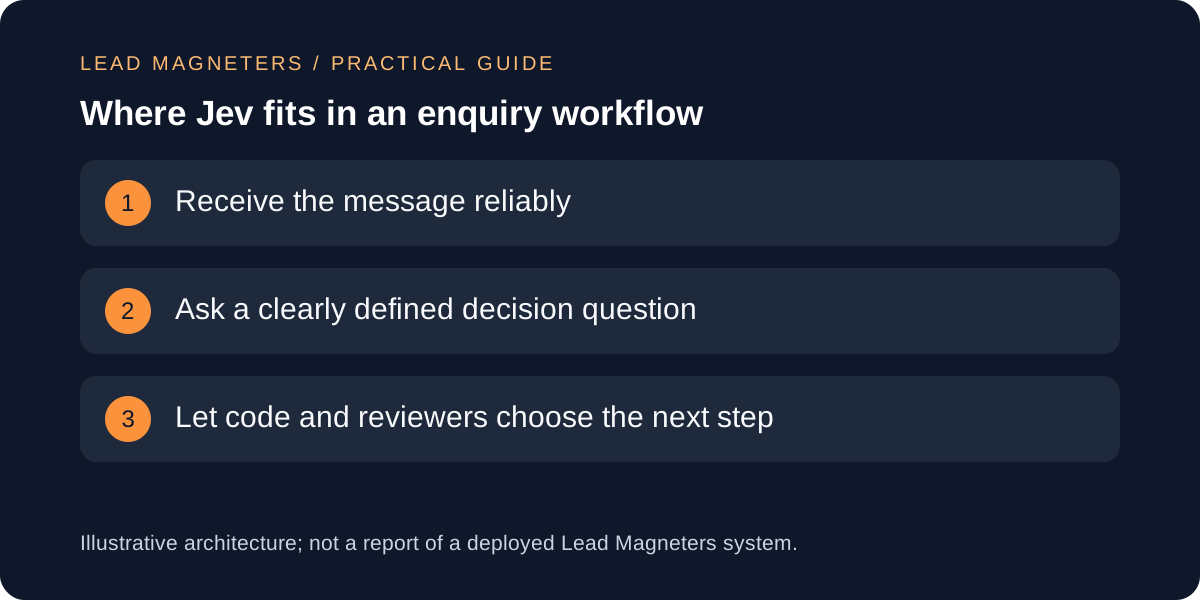
Imagine an agency receiving a short message that asks about a website redesign and mentions an urgent deadline. The business needs several things: a record of the enquiry, an appropriate owner, clarification of the scope and eventually a written reply. A decision model could assist with a defined classification step, while existing software handles record creation and a person approves the response. Breaking the journey into those parts prevents a common mistake: expecting one AI product to replace a complete operating process that has never been documented clearly.
How Jev turns questions into structured answers
The official introduction describes three question types. Choice selects among options defined by the developer. Score evaluates information against a defined scale. Noul returns a value from zero to one for a statement's truth likelihood. Choice and Score also provide distributions and confidence; Noul does not have a separate confidence field. Several questions can be evaluated against the same supplied state. They are independent evaluations, so one answer should not be assumed to become another question's context automatically. The program must organise any dependent steps deliberately.
For the hypothetical agency, a Choice question could distinguish a new project enquiry, an existing client request and an unrelated message. A separate question might assess whether the text explicitly mentions a deadline. Keep these definitions simple enough that reviewers can agree on the intended answer. Include an appropriate uncertain or other route when designing the business process. If every message must be forced into a poorly chosen label, a correctly formatted answer can still send work to the wrong place. The answer types make integration more predictable; the category definitions remain your responsibility.
Jev and language models can serve different roles
A language model remains useful when the task requires drafting, rewriting or explaining information in natural language. Jev's structured decision interface addresses a different need. This does not mean language models cannot produce structured outputs: many support structured response formats too. The comparison should therefore use the same actual task and acceptance criteria, rather than contrast a carefully designed classifier with an unrelated chatbot demonstration. Evaluate both the quality of the decision and the complexity of the surrounding implementation before deciding which approach is appropriate.
A possible architecture is straightforward. Ordinary code checks whether required fields exist. A decision step categorises the message where interpretation is needed. An established routing rule assigns a reviewer. If a draft reply is useful, a text-generation model or a human writes it afterward using approved service information. Deterministic rules should remain deterministic when they already solve the problem well. There is little value in asking an AI to decide whether a required field is empty. Reserve model evaluation for judgments that genuinely need interpretation and have a measurable purpose.
Plan ownership and routing before automation →
Confidence is useful, but it is not permission to act
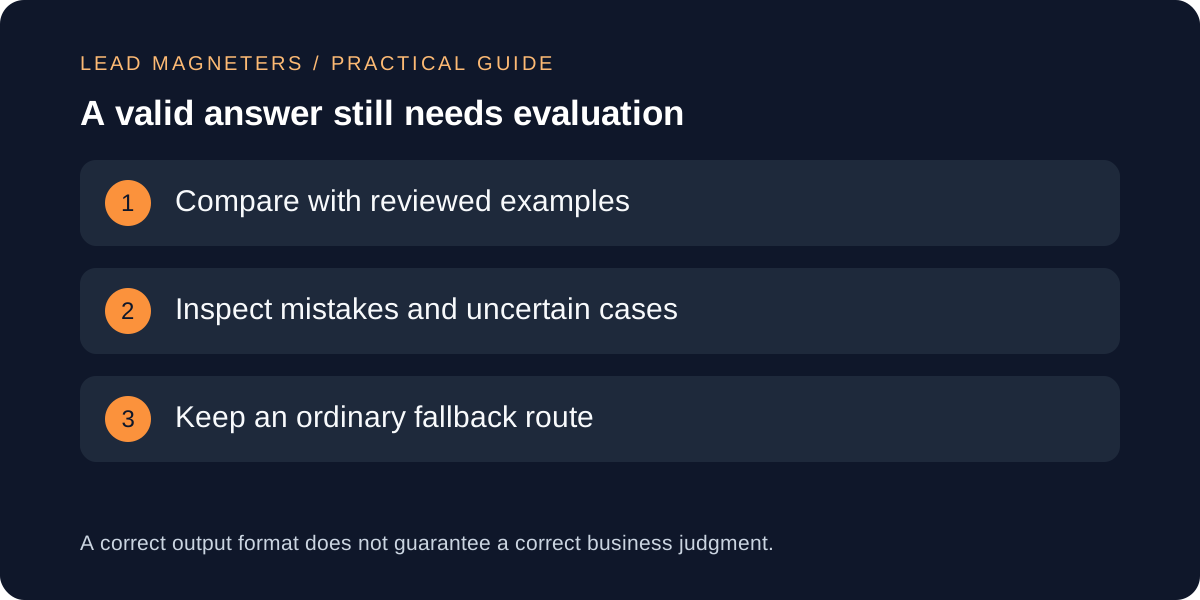
TypeSafe's confidence documentation distinguishes the probability distribution from the confidence statistic derived from its shape. A concentrated distribution signals a clearer preference than a spread-out one. A confidence value should not simply be read as the probability that every aspect of the answer is correct. The documentation recommends choosing action thresholds according to the task and consequences. In practice, the team needs to evaluate those thresholds on relevant examples before relying on them, and preserve an escalation route when the information is incomplete or the options do not fit.
For an enquiry inbox, a reasonable pilot might only suggest a label for a person to review. It should not reject a prospective customer, promise a delivery date or change an advertising budget merely because a model produced a high score. Those actions require separate business authority and checks. Keep a record of the proposed label, the review outcome and the reason for any correction. Over time, the team can identify which kinds of messages cause disagreement and whether clearer definitions, better context or a simpler rule would solve the problem more effectively.
Marketing uses worth testing with real examples
Enquiry triage is one possible experiment: suggest the appropriate service category before the team opens the message. Another is organising customer feedback into a small set of topics so a content planner can see recurring questions. A third is screening a draft against a clearly defined checklist, such as whether it mentions a required service limitation. These are proposed uses to test, not a list of capabilities proven for every language or industry. A useful pilot starts with one of them and a concrete definition of what a good result looks like.
For a company in Istanbul serving Turkish, English and Arabic enquiries, build separate evaluation groups for the languages and message styles that actually occur. Include mixed-language messages, short requests, spelling mistakes and enquiries that mention more than one service. Do not assume a result on polished English examples transfers unchanged to Gulf or local Turkish audiences. Compare the suggestions with reviewed labels and inspect disagreements. A system that saves time on easy messages but mishandles the customers most important to the business may not be a useful improvement, even if its overall accuracy looks attractive.
Read speed and reliability claims in context
TypeSafe's launch materials report substantial speed and cost advantages in its evaluations, while also describing limitations of the comparisons. The company notes that its workflow evaluation uses outputs from other models as reference probabilities and acknowledges possible bias in the selected workflows. Treat those results as a reason to investigate, not as a forecast of savings for your own website. Likewise, a guarantee about output types does not establish that the chosen label is factually correct. A decision can satisfy its schema and still be wrong about the message it was asked to judge.
Measure the whole process when comparing options. Include network time, failed requests, retries, reviewer effort, integration work and the cost of correcting mistakes. Test from the regions where the workflow will run. A business handling enquiries in Turkey or the United States may encounter a different end-to-end experience from a demonstration run near the provider. Review current access arrangements and pricing before approving a budget. This article does not present vendor benchmark multipliers as independently reproduced measurements, and Lead Magneters has not benchmarked Jev for this guide.
Plan a small integration without slowing the website
TypeSafe's quickstart shows a hosted API accessed with a key and a request containing state, a model selection and questions. Developers should use the official reference for the current request format and supported SDKs. An account or API call is not required just to understand the concept. Before connecting a real enquiry form, prepare synthetic or suitably minimised test messages, define who may access the results and review the provider's current data-handling terms. Keep credentials on the server and avoid sending unnecessary customer information merely because it is available in the CRM.
A proportionate design can run classification after the website has reliably accepted the enquiry. The customer should receive accurate submission feedback without waiting for an optional AI label. If the model service is unavailable, place the message in the normal review queue rather than losing it or falsely reporting that delivery failed. Keep the public marketing pages static where practical and avoid adding a browser-side AI library for an internal routing task. These are implementation recommendations for protecting the customer journey, not requirements imposed by Jev or claims that a particular architecture fits every business.
Decide whether a pilot is worth continuing
Start with a reviewed sample, clear category definitions and a simple baseline such as manual tagging or existing rules. Separate examples used to refine the questions from examples used to evaluate the result. Record the model version, question wording and relevant configuration so a later change can be assessed fairly. Define the errors that matter most before looking at results. Incorrectly assigning an enquiry to a neighbouring team may be recoverable; silently discarding it is a different failure. Report those outcomes separately instead of compressing everything into one reassuring percentage.
Continue only if the pilot improves a specific operational goal without creating unacceptable mistakes or maintenance work. That goal might be less manual sorting while retaining review of ambiguous messages. Keep a route back to the previous process and recheck performance when the service list or audience changes. To discuss a possible application, bring a description of the current enquiry journey, the decisions that consume time and anonymised examples you are authorised to share. A marketing consultation can help clarify the workflow and whether technical evaluation is worthwhile; it is not a promise of an existing Jev integration service.