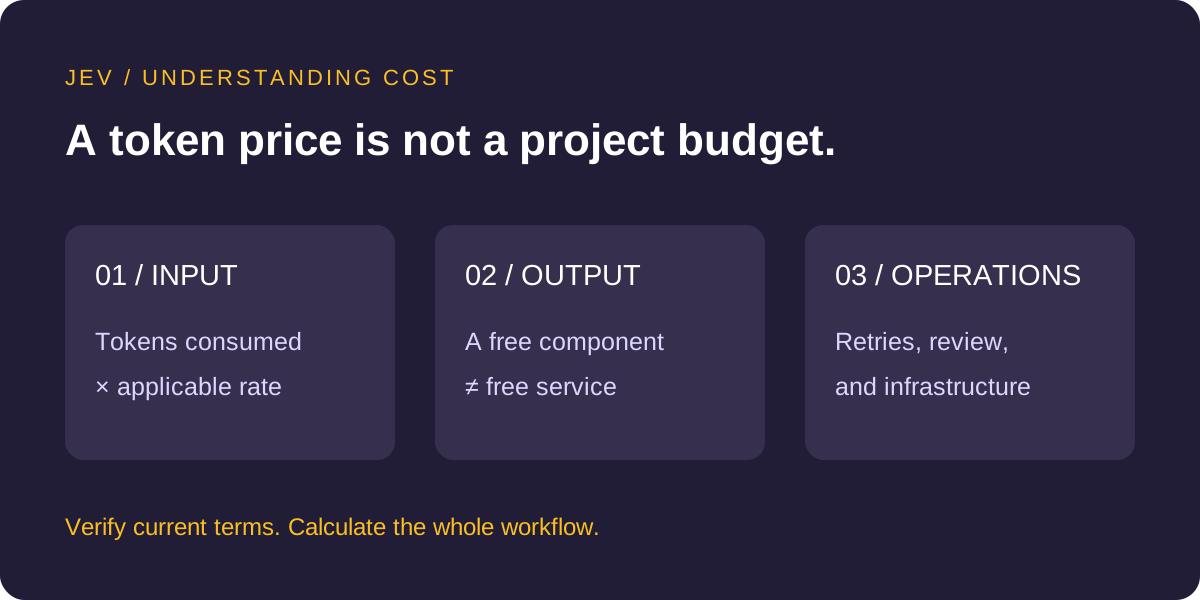
An AI model can look inexpensive on a pricing page and still be difficult to budget for. A tiny token rate does not tell you how much text your application sends, how often it repeats that text, or whether a second system is needed to finish the job. Jev AI pricing is a useful example of why those distinctions matter.
The short answer is that TypeSafe's September 15 launch announcement lists an input rate of $0.042 per million tokens and describes output tokens as free. That is not the same as saying the entire API is free. Treat the figure as a dated published rate, and confirm the terms that apply to your actual account before estimating a bill. Source: TypeSafe launch announcement.
This guide separates published pricing from illustrative calculations. It does not report a bill we received, promise a free allowance, or claim that Jev is cheaper for every task. The goal is to make the arithmetic understandable and the missing assumptions visible.
Is Jev AI free?
Three questions often get compressed into the word “free”: whether an account can be opened without payment, whether trial usage is available, and whether production requests incur charges. Those are separate arrangements. A free output component does not establish a free subscription, unlimited requests, or a permanent trial.
Do not build a forecast around credits that you have not actually been offered. If a dashboard grants a temporary allowance, record its expiry date and the charges that begin after it ends. If the terms are unclear, leave the allowance out of the base estimate. It is better to treat a confirmed credit as a discount than to assume it is the product's normal price.
Also distinguish the service from a website using a similar name. The provider's homepage identifies the product and links to its documentation and console. Use that starting point when checking account access; an independent tutorial is not evidence of your billing terms. Source: TypeSafe AI.
How to calculate an input-token estimate
For a simple model with a constant rate, multiply the number of requests by the average input tokens per request. Divide that total by one million, then multiply by the input rate. This gives an input-only estimate, not a complete invoice. Use the actual metered input definition from your provider when replacing the assumptions with measured usage.
Suppose a fictional experiment sends 10,000 requests, each averaging 2,000 billed input tokens. That totals 20 million input tokens. At an assumed rate of $0.042 per million, the calculation is 20 multiplied by $0.042, or $0.84. These numbers describe a hypothetical workload, not a measured Jev deployment.
Now change only the average request size to 20,000 tokens. The same request count produces 200 million tokens and an $8.40 input estimate. The tenfold difference comes entirely from input size. Counting requests without counting their contents would hide it.
| Hypothetical requests | Average billed input tokens | Total input tokens | Input-only estimate at $0.042 / million |
|---|---|---|---|
| 1,000 | 2,000 | 2 million | $0.084 |
| 10,000 | 2,000 | 20 million | $0.84 |
| 100,000 | 2,000 | 200 million | $8.40 |
| 1,000,000 | 2,000 | 2 billion | $84.00 |
The table is original arithmetic using the dated rate cited above. It excludes taxes, any account-specific fees, other providers, storage, and application operations. Actual billing rules and rounding may differ from a simple estimate.
Why document length is not the whole input
A useful cost worksheet should account for the complete request, not just the obvious document. Instructions, options, rubrics, and repeated context can all add material. Avoid assuming that a thousand words correspond to one fixed token count across languages and document types. Measure representative requests rather than relying on a convenient universal conversion.
Include variation as well as the average. A library of short notes with occasional long transcripts might have a very different monthly profile from a library containing only short notes. A budget based on the first few easy examples can miss that distribution.
For an initial estimate, create small, typical, and large request scenarios. Give each an expected share of traffic and calculate the weighted total. Keep the assumptions in plain sight so another reader can challenge them. A spreadsheet with explicit inputs is more useful than a precise-looking monthly total whose origin nobody remembers.
Can batching questions reduce Jev API cost?
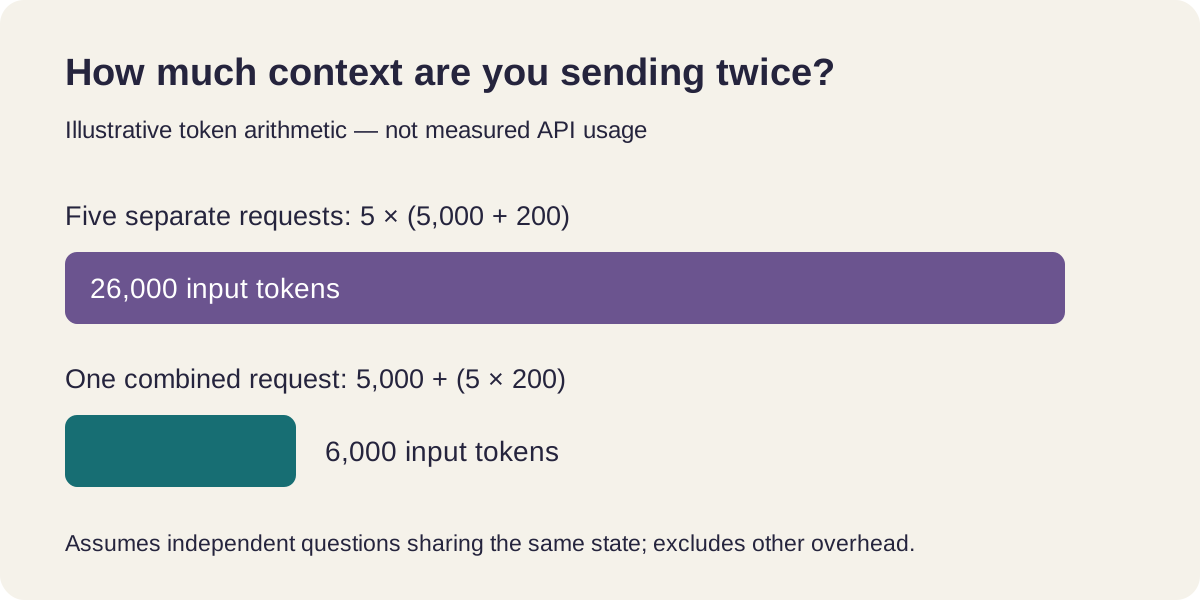
TypeSafe documents asking several independent questions about the same state in one request. Its primitives guide says those questions are evaluated independently, and distinguishes that pattern from a later question that actually needs an earlier answer. Source: TypeSafe primitives documentation.
Here is an illustrative way to think about repeated context. Assume a state takes 5,000 input tokens and each of five questions adds 200. Sending the state separately with every question totals five times 5,200, or 26,000 tokens. Sending it once with all five questions totals 6,000. Under those simplified assumptions, the combined input is about 76.9 percent smaller.
This is not a measured performance claim or a guarantee about exact billing. It leaves out transport details and assumes every question genuinely needs the same state. Its value is showing where repetition can arise. Verify real usage before treating an illustrative reduction as a forecast.
Do not batch dependent work just to force a lower estimate. If an answer determines which document must be retrieved next, the next request has a real dependency. Correct task structure matters more than creating an attractive token comparison.
The costs that a token table leaves out
API charges are one part of operating software. Preparing documents, maintaining access controls, saving results, and investigating failures also consume resources. An inexpensive model call does not make these responsibilities disappear. Depending on the project, development and review time may be more significant than the token line item.
Retries deserve their own assumption. If an application repeats work after a timeout, duplicate requests can increase consumption. Separate the number of intended tasks from the number of actual calls. Log enough information to detect repetition without storing unnecessary private content, and define retry limits before a temporary failure creates an uncontrolled loop.
A second model can change the picture too. Imagine a system that makes a classification and then asks a text model to explain the result. Those are two services with potentially different charging rules. Count the explanation step rather than presenting the decision component's rate as the cost of the whole experience.
Human review is another distinct line. Asking a person to inspect uncertain results may be the right choice, but it takes time. Budgeting that time is not an argument against review. It is a way to compare systems honestly, including the safeguards needed to make them useful.
Is Jev cheaper than another AI model?
A useful comparison requires an equivalent task and an acceptable result. Comparing one system that returns a short category with another that writes a detailed report answers little about which is more economical for the same job. Decide what the application needs before choosing the comparison metric.
For a document-labeling experiment, useful measures might include cost per accepted label, the fraction sent for review, and the error rate on checked examples. Record processing time separately. If one configuration returns faster but creates more corrections, the speed advantage alone is not a complete conclusion.
Avoid importing a vendor's broad savings multiplier into your own forecast. Even when the underlying demonstration is valid, its input sizes, settings, and task definitions may differ. A transparent estimate should name those differences instead of making them disappear behind a headline number.
A practical checklist before spending money
Write down the provider, model identifier, price-check date, and currency. Confirm whether you are connecting directly or through another service, and inspect that service's own billing terms. Record any usage restrictions, spending controls, and account allowances that are actually documented for you.
Then estimate a small experiment with a fixed stopping point. Use non-sensitive sample material, inspect reported usage, and compare it with your worksheet. Investigate meaningful differences before increasing traffic. This step tests the budget model as much as the AI model.
Finally, set a review date. An early estimate should not become an unquestioned permanent assumption. Input lengths, traffic, model choices, and provider terms can change independently. Keeping the worksheet current is often more valuable than calculating the first version to six decimal places.
The bottom line on Jev AI pricing
The interesting question is not simply whether the published number is small. It is whether you can connect that number to a realistic request pattern and a useful outcome. Separate input charges from free-output language, and separate API arithmetic from the wider cost of running an application.
With that distinction, pricing becomes easier to reason about. You can estimate an experiment, identify the assumptions that need testing, and compare alternatives without pretending that a launch announcement is your invoice. That is a stronger basis for deciding what to try than either dismissing a low price or accepting it as a universal savings guarantee.
Editorial references and image credits
- TypeSafe launch announcement, September 15, 2026: dated published input and output pricing.
- TypeSafe AI: official product homepage and account/documentation links.
- TypeSafe primitives documentation: independent questions sharing a state and real request dependencies.
Research date: September 20, 2026. No account was opened, paid request sent, or customer invoice examined. Figures are hypothetical calculations, not benchmarks. Both 1200 × 600 SVG illustrations are original and contain no third-party logos. Search volume has not been measured; the keyword choice reflects a distinct pricing intent, not a guarantee of traffic.